Jan 24 2010

Menestra de porotos or bean stew

A menestra is a popular stew type dish made lentils or beans and served with rice, plantains, salad and your choice of protein: beef, pork, fish, chicken or an egg  (vegetarian option).  The menestra de lentejas is most common type of menestra that you will find in Ecuador.  My mom, with her background in New Mexican food, made menestra de porotos or beans more frequently than menestra de lentejas.  She is probably to blame for my intense dislike of canned beans; once you get used to cooking beans from scratch it is really hard to eat bland canned beans.  Yes, you can add spices and flavor to canned beans, but it doesn’t compare to homemade cooked beans.
In Ecuador you can find a huge variety of beans,  I love going to the market and looking at all the different colors of beans.  Menestras are usually made with dry beans, however one of my favorite is menestra de porotos tiernos or fresh beans.  Fresh beans are harder to find here in the US, though I did see some last summer at the farmer’s market and will try a fresh bean menestra this summer.
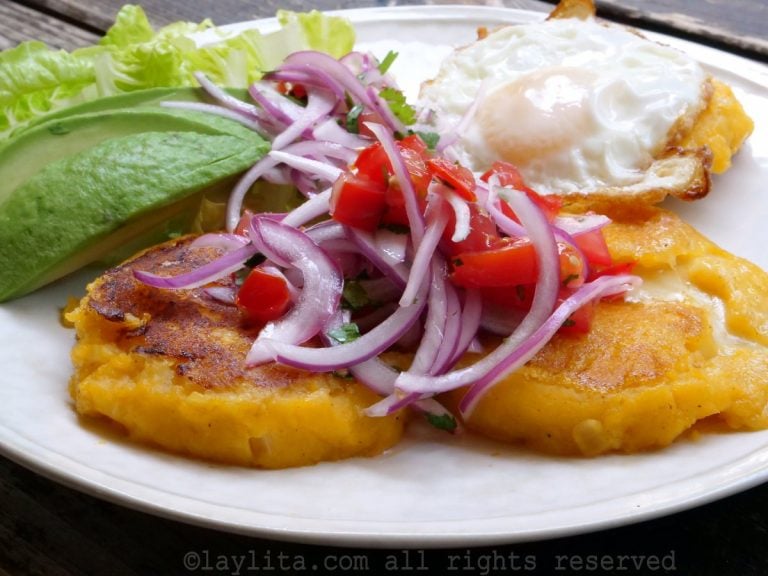
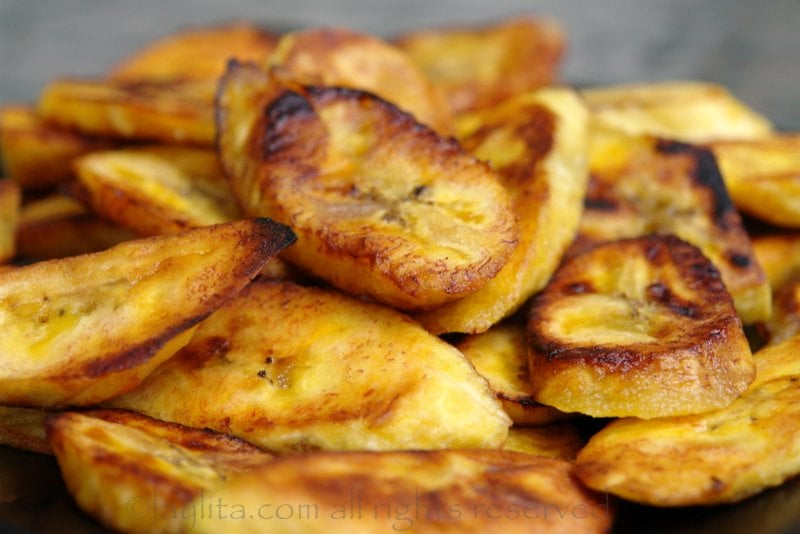
A menestra would not be a true menestra without the essential side dishes: rice (a must – no substitutions) helps soak up the sauce that the beans simmered in. The fried ripe plantains complement the dish with a nice sweet touch. Some avocado slices and a small side salad, with onion and tomato curtido, add freshness and acidity. Finally, most restaurants will offer you a choice of fried or grilled meat, pork, chicken, or fish, with the menestra.  When I was growing up, my mom tried to limit the amount of meat we ate, so it was very common for her to serve this menestra de porotos with a fried egg instead of meat. If you are vegetarian and are ordering this dish at a restaurant you can also request an egg in place of the meat.
The beans in the menestra get their flavor from simmering the spices and vegetables that make up the refrito or base of the dish. The refrito for this menestra is made with diced red onions, diced tomatoes, crushed garlic, achiote or annatto powder, cumin (both whole and ground, and chili powder; very basic ingredients that add a lot of flavor to the beans.  The final touch is the chopped fresh cilantro or parsley that is added at the end. This bean menestra is a very easy dish to make; it takes a couple hours to cook and the beans need to soak overnight, but the preparation is very simple.
Ingredients (for 8-10 large servings):
1 lb dry beans, soaked overnight
2-3 tbs canola oil
1 red onion, diced
6 garlic cloves, crushed
1 cup of diced and peeled tomatoes (fresh or canned)
½ tsp achiote powder
1 tsp cumin seeds – whole
1 tsp ground cumin
1 tbs chili powder
8 or more cups water
2-3 tbs finely chopped cilantro or parsley
Salt and pepper to taste
Preparation:
  1. Heat the oil over medium heat in a saucepan or pot, add the diced onions and crushed garlic, let cook for about 2-3 minutes.
  2. Add the diced tomatoes, achiote powder, cumin seeds and ground cumin, chili powder, salt and pepper. Cook for another 5 minutes, stirring occasionally.
  3. Add 8 cups of water and bring to a boil.
  4. Add the soaked beans and simmer for about 2 hours.
  5. Mix in the chopped cilantro or parsley.
  6. Serve with Ecuadorian style cooked rice, fried plantains, salad with tomato and onion curtido, fried or grilled meat (or fish /poultry/egg), avocado slices and some good aji or hot sauce on the side.

  • Share/Bookmark

8 responses so far

Jan 17 2010

Ernestine’s potato gratin dauphinois

Intro – I would like to introduce the newest contributor to this blog,  my wonderful husband Nico. Nico is the occasional cook in the house. He grew up watching his parents make typical French recipes and since he lived in different parts of France over the years, he got to see specialties from various regions. His favorite recipes are simple, quick and easy to make, he refuses to cook anything that would take more than 2 hours to prepare. I hope you enjoy his recipes. ~Laylita

I spent several years of my childhood in the French Alps in a town called Saint Jean de Maurienne, in the county of Savoie. It is nested between mountains in the middle of a valley crossed by the Arc river. The town is known for its traditional industries such as old style knives (“Opinel”), tourism as a hub for skiing and mountain activities, as well as a fast route to Italy, now less than 90 minutes away using the new highway that takes drivers straight through a long tunnel underneath the Alps, and into Italy (“le tunnel du Frejus”).

During these years, I lived with my Grandma who herself was born in Sicily and had spent most of her life near Saint Jean, in France. For several years she had a mountain restaurant in a very tiny village called Albiez, right above Saint Jean. The mountains carry spectacular views. The climate is continental, which means that summers are hot and winters very cold with lots of snow. Food is inherently tied to people’s customs, the ingredients available, and of course, influenced by the climate.

Gratin dauphinois is a typical dish from the French Alps made with thinly sliced potatoes baked in a sauce of milk, eggs, cream and garlic and topped with cheese. A bit of etymology. The Alps have a region called Dauphiné which includes 3 French counties: Isere, Hautes Alpes and Drome. The adjective derived from the Dauphiné region is called Dauphinois, such as the inhabitants or for the recipe at hand, the dish. Gratin comes from the French verb “gratter” which means to scrape or grate (e.g. cheese or potatoes). So its name and regional roots make the gratin dauphinois an excellent winter dish that is tasty, nutritious, and particularly appreciated in mild and cold months. It is a popular menu item in local restaurants in the Alps and a top pick from hikers and skiers to replenish their energy levels after a day on the mountains.

Continue Reading »

  • Share/Bookmark

11 responses so far

Jan 16 2010

Culinary Tour of Quito – Part 2

Print This Post Print This Post Published by Laylita under All, South America

This is second part of our culinary tour thru Quito, in the first part Matt and Olga –those students in love  - took us on a tour of some their favorite places in the city.  Marc and I also had our own gastronomical adventure in this historic colonial city and will share our story.    For those who don’t know, Marc is my 3 ½ yr old and this was his first time to visit Quito.

I grew up in Loja -southern highlands of Ecuador- and have vague childhood memories of traveling to Quito. One the visits that stands out the most was when I was 9 or 10 yrs old and it was just my mom and I. We stayed with one of her friends, not sure where but it seemed like it was part of the Old Town area. The most vivid part of that visit was a small tienda or store on one of the corners that had some of the best “helados de palo”, which are Ecuadorian popsicles: ice cream on a stick. The sticks are made from cana brava, a type of bamboo; while the ice cream part is placed in small tin molds with a stick in each one and then frozen. The most common helados de palo are milk ones, consisting of just milk boiled with cinnamon and sugar, then placed in the molds with a stick and frozen. Other popular variations are made with gelatin (watered down obviously) and coconut, one of my favorites is coconut with a thin layer of strawberry gelatin.  This small tienda had helados de palo made with cream and they were amazing (and very addictive – I spend most of the money my mom gave me at that store).

I also vaguely remember another summer in Quito as a kid with some friends, but this time we spent the whole time in a suburb (Tumbaco) of the city in a big house with mean ladies who would force us to eat everything (including mellocos – slimy potatoes which I hated but now  love). The house was surrounded by citrus fruit trees and one of the days we were there we went down to the street/highway to watch a bunch of cars racing in a rally. That’s about it for my childhood memories of Quito. As a teenager going to Quito was a different experience, it was typically with high school friends and involved partying or concerts (not many international singers came to our hometown of Loja so if we wanted to see them we had to go to Quito).

Now going to back to Quito as a parent with a 3 yr old was a new challenge. I’ll admit I was a little nervous at first about traveling to Ecuador alone with him. However, the minute I arrived those fears were gone, people in this country are very child friendly. Even in situations where he was loud or annoying, and I was expecting people to give me evil looks, instead people would tell me: “Oh, don’t worry, he’s just being a kid.”

One of the things to keep in mind about Quito is the effect that the altitude (2850 mt or 8464 ft) will have on you, basically you will walk a few blocks and feel out of breath, at least for the first days. For Marc, who is extremely lazy when it comes to walking – his favorite comment when we go hiking is: “I like hiking, but I hate walking”,  it was a little bit challenging to adjust to the altitude. Luckily for him though is that in Quito –and everywhere in Ecuador – there is an abundance of cheap taxis; he quickly discovered that to avoid walking you could just get a taxi. Of course there a lot of areas that are great for walking in Quito, but it is a large city so taxi’s are convenient to get from one place to another.

The weather in Quito is relatively mild, usually in the 60’s (F) during the day, and cooler –low 50’s- at night.  The main problem with the weather is that it can go from sunny to aguacero (major downpour) in minutes, so it’s a good idea to dress in layers. If you plan on going to the Teleferico  - a cable car that takes you to the top of one of the volcanoes – take a warm jacket as it is very cold up there.

Breakfast

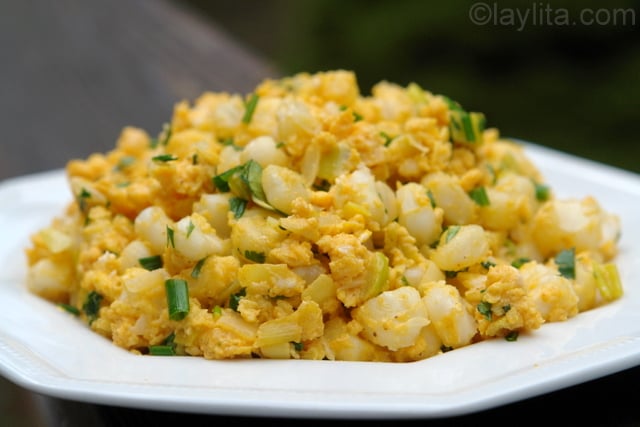
We started our day by having breakfast with our good friend Mafi, who hosted us while we were in Quito. She prepared some delicious torrejas de choclos or fresh corn fritters with freshly made orange juice.

Capilla del Hombre

After breakfast we took a taxi to the Bellavista neighborhood to visit La Capilla del Hombre or the Museum of Man. It is a tribute to both the oppression and pain of people in Latin America, but also to the hope keeps them fighting for their dreams. This museum was built by Oswaldo Guayasamin, Ecuador’s greatest artist.  Guayasamin started the museum in the mid 90’s, but then passed away in 1999, and the museum was completed in 2002. One of my favorite parts is the mural that covers the inside of the dome,  he was working on it when he passed away and it was left unfinished – it is beautiful, you would not know that it was an unfinished piece of art unless someone told you.

Mercado Santa Clara

Next we went to the Santa Clara fruit and vegetable market. Even though Matt and Olga were visiting the same market for lunch, Marc and I also wanted to check out. I wanted to get some fresh fruits and Marc wanted to get some flowers for Mafi. Flower exports are one of the main industries in Ecuador and a lot of them are grown in the areas around Quito. They are also very inexpensive; you can get a nice bouquet for $1. One the fruits that I miss the most are babacos, I’ve heard they’re called mountain papayas in English. Babacos are juicy and sweet inside, a fruit so perfect that doing anything other than eating it plain doesn’t do anything to improve it. The market also brought back a lot of old memories of things so typical in Ecuador: buying fresh already peeled beans;  finding fresh herbs such as chamomile, lemon verbena, lemon grass; stands selling “cures” for “espanto” – a cure for people (mainly kids) that have been frightened by something or someone (sometimes this also involves witch craft or evil eye). You also can find all different types of meat and seafood in the mercado, as a kid I hated going through the meat section, seeing the dead animals was scary (at least there was a cure nearby in case I got seriously frightened) .

Continue Reading »

  • Share/Bookmark

7 responses so far

Jul 07 2009

Chaulafan de pollo or Ecuadorian chicken fried rice

Chaulafan de pollo or Ecuadorian chicken fried rice

Some time ago I posted a recipe for arroz on pollo or chicken rice; while it was popular and I received good feedback on that recipe, the most common feedback was along the lines of  “this is great, but where’s the other arroz con pollo or chaulafan de pollo?”.  I’ve been meaning to post this for a while, sorry it’s so late for those requested it (but better late than never, right?).
Chaulafan is an Ecuadorian version of fried rice. There are many different types of chaulafan: shrimp, chicken, pork, mixed.   In most major cities in Ecuador you will find chifas or Chinese restaurants, these are usually the best places to eat chaulafan; you can either eat at the restaurant or take it to go. When I was in high school in Loja, there was a chifa right across from the home of one of my best friends, it always made me so hungry every time I walked by that place.

Chaulafan de pollo or Ecuadorian chicken fried rice

Continue Reading »

  • Share/Bookmark

36 responses so far

Jun 28 2009

Foodbuzz 24, 24, 24: Culinary Tour in the Middle of the World

Print This Post Print This Post Published by Laylita under All, South America

View of Quito from El Ventanal restaurant

Our plan when we submitted our proposal to Foodbuzz for this month’s 24, 24, 24 (24 Meals, 24 Hours, 24 Blog Posts) was to take you on an extensive culinary tour through the city of Quito, the capital of Ecuador, located in the middle of world.  There were so many places and so many different foods we wanted to try and share with you, but how we could possibly do this in just 24 hours? So, we split up into two teams: on Team 1 we have two students in love: Matt (my French brother-in-law) and Olga (his beautiful Ecuadorian girlfriend); and on Team 2, we have yours truly and Marc (my 3 yr old).  Team 1 is going to show you the more romantic side of the city, while Team 2 is going to show you that even a 3 year old can enjoy a gastronomical adventure in one of the oldest cities of South America.  This is a long story to tell in one post, so we will split this story into two parts. The first part is Matt and Olga’s adventure. Enjoy!

Matt and Olga during breakfast
Photography/narration by Matt and Olga
Quito is an exciting mix of both old and new: colonial buildings huddled next to local skyscrapers and US style shopping malls, on the busy streets business professionals stride pass indigenous musicians, fruit and craft sellers. Quito, 2850 meters high (that’s 8,464 feet above sea level), has perfect spring weather thanks to its location in the heart of the Andes. You know you’re in the Andes wherever you walk because you are constantly out of breath (this is not true for the locals who are accustomed to the altitude). The city is surrounded by marvelous volcanoes, including the Pichincha to the West as well as the Antisana and the Cotopaxi – the highest active volcano in the world. Quito not only offers a spectacular natural setting, but it has also an exceptional historical and architectural wealth. Indeed, it was the capital of a much bigger area called “The Kingdom of Quito”, this explains the high concentration of colonial churches and museums. In 1978 the city was first in the world to receive World Heritage Site status from UNESCO.
We’re pretty sure you’re not aware yet of how cool this city is, but we hope we’ll convince you with this brief panorama of the quiteño’s daily life. Indeed, our main goal while participating in Foodbuzz 24-24-24 was to show the world all the quality food, culture and “stuff” our little cozy country has to offer. We could spend hours promoting this incredible spot on Earth but this is not the aim of the event. However, we strongly recommend this great place called Ecuador because of its rich diversity: mountains, beaches, the Galapagos and the Amazon jungle.
We decided to give you a glimpse of both Quito old town (Center) and new town (North); the goal of this day was food, food and food, in fact we had the feeling we did not stop eating.

We started our day in the Centro Historico or Colonial Center of the Quito, one of the most impressive things in this city is that you can find food everywhere: walking in the streets, at traffic light stops, and so on; the same is also true for local street artists and lottery ticket vendors.

Helados de coco or coconut popsicles Corn and limes for sale at the traffic light

Street performer in Quito Indigenous lady selling lottery tickets Man selling ice cream on the street
Breakfast in the Colonial Center

Olga and I spent a month in Quito in 2006 and one of the restaurants we went to back then was Tianguez, located under the San Francisco atrium on the Plaza by the same name.  We came back because of the incredible location and the good vibes of the place.
Tianguez restaraunt on the plaza San Francisco

Our waiter John welcomed us warmly and the chef allowed us into his kitchen to take photos while he prepared a fruity milk shake.   For breakfast Olga had a tasty humita – a fresh corn cake stuffed with cheese and steamed in the corn husk, and the tree tomato milkshake. Tree tomatoes, also known as tamarillos, are a typical fruit from Ecuador; they are used frequently to make fresh fruit juices, as well as to make the traditional aji de tomate de arbol or spicy tree tomato salsa.

Our great waiter John showing off our traditional breakfast

Julio showing off the traditional food

Inside view of Tianguez restaurant

Tianguez Tianguez

The chef preparing a tree tomato milk shake

The chef at Tianguez peeling a tree tomato Blending the tree tomatoes

The chef at Tianguez dsc00606 Tree tomato milkshake

Traditional humitas or fresh corn cakes steamed in corn husks

Humitas or steamed fresh corn cakes

Continue Reading »

  • Share/Bookmark

27 responses so far

Jun 13 2009

Mousse de maracuya or passion fruit mousse

Mousse de maracuya or passion fruit mousse

Mousse de maracuya or passion fruit mousse is a delicious and easy to make dessert, which is also very popular with friends who have tried it; in fact the first time I made was when one of my friends requested that I make it for dessert, she had passion fruit mousse in Brazil and loved it. The easiest way and most typical way to make this dessert (and many others in South America) is to use condensed milk.  I used condensed milk that first time and was not too crazy about, however when I added a spoonful of fresh passion fruit pulp on top of the mousse and some whipped cream on the side the taste improved dramatically. In fact combining the whipped cream and the mousse reminded of these amazing passion fruit and cream popsicles that I used to eat in Ecuador, and that was exactly the flavor that I wanted to obtain in the passion fruit mousse.  The second attempt was much more successful; I eliminated the condensed milk and replaced it with heavy whipping cream, I also added some fresh passion fruit pulp into the mix; it worked out very well.  Now, it is a question of preferences, I have a lot of friends that are crazy about condensed milk and they might have preferred the taste of the mousse with condensed milk; you can also do half condensed milk/half whipping cream version if you want the best of both worlds. Another reason I prefer using only the whipping cream is that it made the texture of the mousse a lot more fluffy and spongy.

Mousse de maracuya or passion fruit mousse

Continue Reading »

  • Share/Bookmark

14 responses so far

May 27 2009

Asparagus risotto

Asparagus risotto

In South America we eat rice with almost every meal, typical lunches include arroz (rice) with something: pollo or chicken, carne or meat, pescado or fish, camarones or shrimp or even just a huevo frito or fried egg.  Rice was always something very basic, nothing fancy, so when I heard of something called risotto it sounded very exotic and sophisticated; all of sudden rice was no longer something plain, you could make it “fancy”, at first I was a little bit afraid of even trying to cook risotto -especially after watching all these Italian movies that depict making risotto as some sort of secret heart surgery. So, it took me a while to talk myself into making it at home but finally I bought some Arborio rice at Trader Joe’s and just made a basic risotto following the instructions on the back of the box and it came out really good. After that I felt confident enough to get creative and make different types of risotto, adding meat or seafood or vegetables; basically it is an easy dish to make, very versatile and a good one to impress people (especially if they’ve been traumatized by those Italian movies).
This asparagus risotto is a great way to enjoy all that yummy asparagus that is in season right now. I typically use chicken broth but you can also use vegetable broth if you want to keep it a vegetarian dish.  My Italian friend Rossana says that she always adds a cube of chicken bouillon at the end (when you add the cream) and that it gives the risotto even more flavor. I love to add a drizzle of truffle oil when serving it, it gives it a nice finish; you can also use olive oil to drizzle if you don’t have truffle oil.  Finally, risotto is best when it is eaten as soon as it is made. Risotto can be served as an appetizer in small portions or also as a main dish in larger portions.
Asparagus risotto

Continue Reading »

  • Share/Bookmark

13 responses so far

Next »