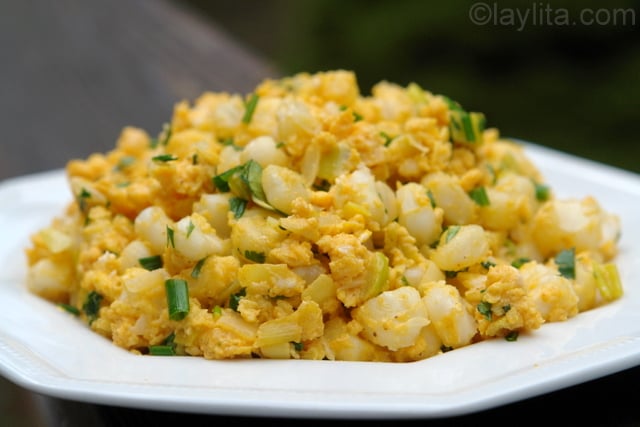
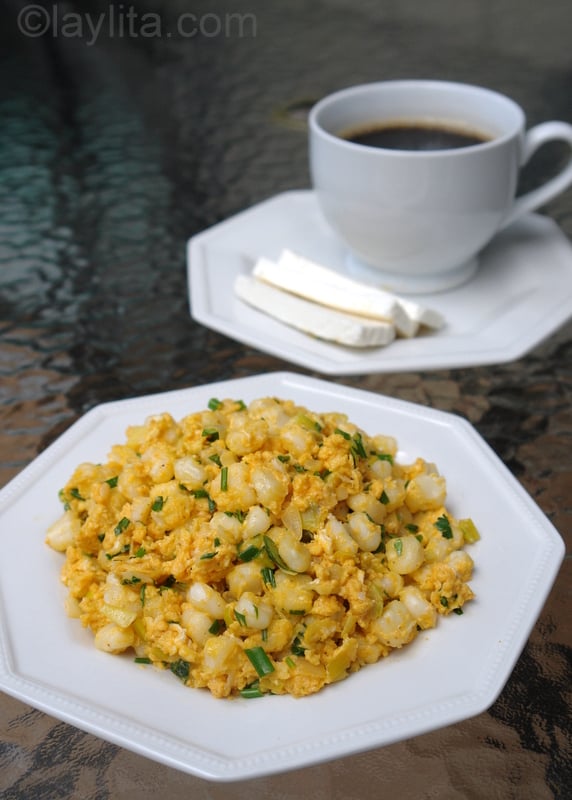
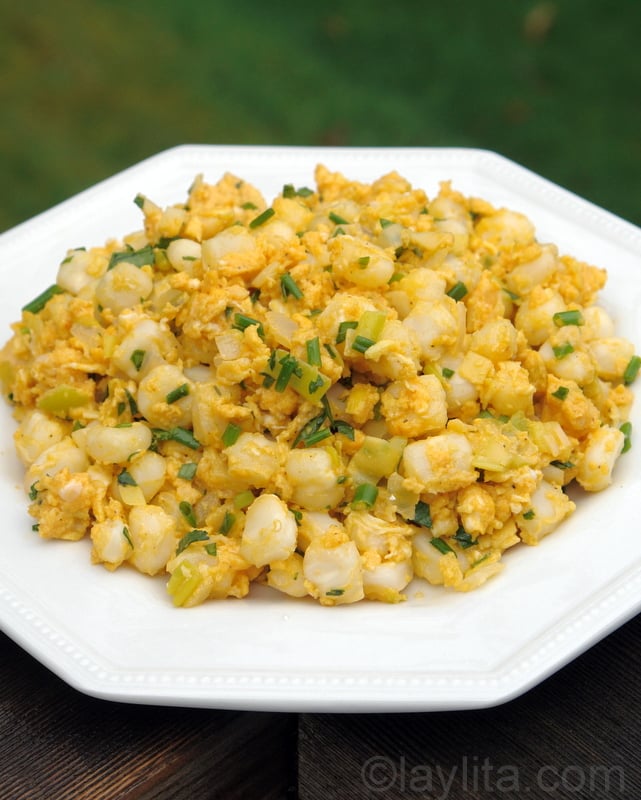
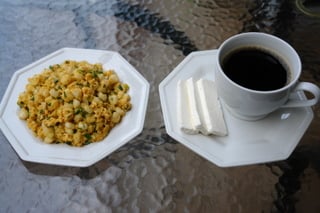
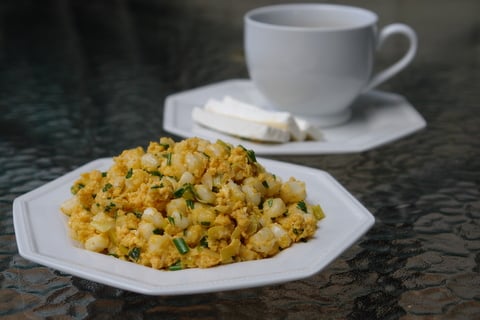
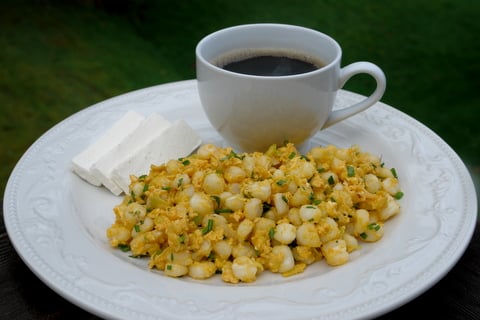
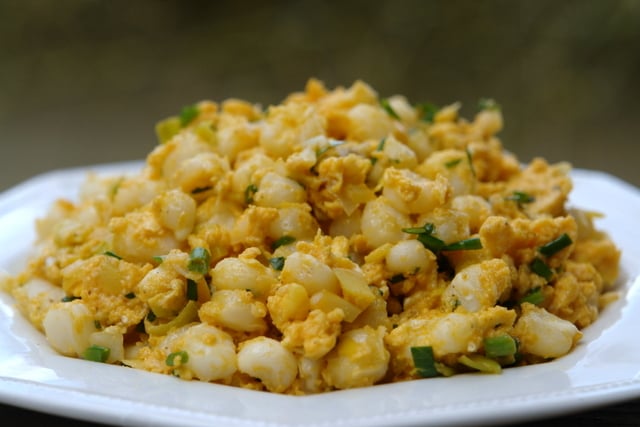
Mote pillo, also called motepillo, is a dish of hominy fried with scrambled eggs. It is the perfect breakfast or brunch dish. Mote pillo is a typical dish from the highlands or Sierra region in Ecuador. The city of Cuenca (and the whole province of Azuay) claim this dish as their specialty. To me this is really one of the best comfort foods, like many other dishes from the Sierra it warms me up inside when I eat it. Mote pillo is very easy and quick to make: the mote or hominy is sautéed with onions, garlic, achiote, eggs, milk, chives and cilantro or parsley. Mote pillo is almost always served with hot black coffee and slices of fresh cheese. Mote or hominy is dry corn that has been peeled and then boiled until soft, it is very easy to find it already prepared and canned in most grocery stores, usually in the canned vegetable section or in the ethnic section.

Ingredients:
1 lb cooked mote or hominy (can use canned hominy)
2 tbs butter
4 eggs
1 cup of chopped leeks (white part only) or white onion
2 garlic cloves, crushed
¼ tsp ground achiote
¼ cup milk
2 tbs chopped chives
1 tbs finely chopped cilantro or parsley
Salt to taste
Serve with: Queso fresco slices and black coffee
Preparation:
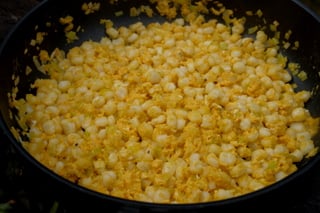
- Heat the butter over medium heat in a large sauté pan, add the chopped leek or onions, crushed garlic, achiote and salt to make a refrito, cook until the leeks are soft, about 5 minutes.
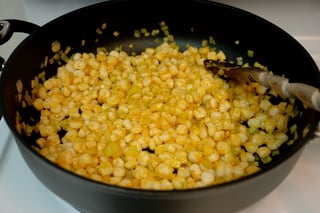
- Add the mote or hominy, stir in well and cook for another 2 minutes.
- Add the milk and cook until the milk is almost all absorbed by the hominy.
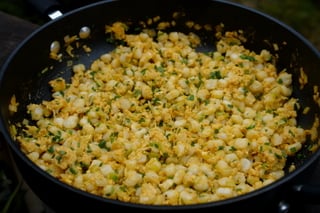
- Whisk the eggs and add them to the hominy, stir well and cook for about 3-5 minutes.
- Stir in the chives and cilantro and add additional salt if needed.
- Serve accompanied by queso fresco slices and hot black coffee.


Layla, this looks good! I wonder how this would work with some yapingacho (peanut butter) sauce and maybe some chopped peanuts mixed in.
Or, for a fusion taste, add a little curry powder and substitute tofu for cheese. Either way, I’d sure like to try this one out!
I’ve been looking for breakfast recipes and also needed to use up the extra hominy from making Posole! Thanks! Ate with corn tortillas and salsa verde.
Thanks so much for the recipe! My daughter and her family live in Cuenca (her husband is a Cuencano) and I have had the joy of visiting there twice. I’m working on a book for kids set in Ecuador, and needed to remind myself of some of the traditional Ecuadorian foods I had eaten there. I LOVE Cuenca, and can hardly wait for my next trip there, not only to see my daughter and grandchildren, but to be in that beautiful city again and to travel through the country.
Went to visit my son and his wife in Cuenca. She is from there and they just moved to Ecuador in April. I went the first of September, loved the food. This was so good and we had it and blanco at ever meal. Found the hominy at the grocery store and am ready to make it at home. Really looking forward to it.
Layla, I bought dried mote in Cuenca recently, so that I could make my own mote dishes. Question: do I need to soak/cook the dried corn kernels in Cal (quicklime) or can I just cook it for 3 hours, as the package direction states? I have no idea where to find quick lime here, can you assist?
Sarah – If you bought dried mote it has already been treated with cal, so you just need to boil, here are some instructions: http://laylita.com/recipes/2009/01/16/mote-or-hominy/
I love your recipes!!! They are very authentic and I know how they are suppose to taste because I was born and lived in Ecuador half of my life. In South Florida it’s very difficult to find ecuadorian food and if you find it doesn’t taste like the real thing. You should be proud of yourself because you acomplished that and you just told me how to make it. I can imagine how your food taste, you should open a restaurant. =)
I made this and blogged about it. :)
http://the10centdiet.blogspot.com/2010/06/hominy-egg-scram.html
What a lovely website you have. I was searching for the recipe of a wonderful hominy dish I had at breakfast on the Athala cruiseship around the Galapagos two summers ago. I have been to Ecuador twice now-one for volunteer dental treatment of the children near Cuenca and then the trip to the Galapagos. All the food was wonderful but the Mote Pillo stood out. We have having a latin flavored party this weekend and I will make the mote pillo the next morning. I live in a country area of Pennsylvania and bags of dried hominy are very easily attainable. Popular here in cow and corn country. I have a large bag in the pantry. Thank you for the high quality pictures and I look forward to searching around your site.
It’s really nice to know that someone out there appreciate this healthy food as much as I do. Modern times are killing our precious food legacy, not because they show any difficulty at the time of cooking, but because of lack of knowledge about food concepts. I was born in Ecuador and grew up eating all these delicious and nutritious snacks, it was a shame tough, knowing that this kind of corn “mote” was only used to feed horses and cows in Europe! I am proud of showing that hominy is edible for humans too, and I got to make it as in mote con chicharron once and mote pillo twice, well my husband, who is Dutch, still doesn’t like it, but he likes maiz tostado in his ceviche! and that’s a major achievement. :=)
As a writer, I’ve found a lot of exotic, odd type of food and drinks, which is my speciality, and it’s amazing to see how corn is used for so many types of concoctions. It’s such a great cereal. Chicha de Jora is an example.
Keep up with your good work!
Karina
ps. by the way I am currently cooking your delicious seco de pollo recipe, oh kitchen smells so goood…!
Thank you for this recipe this looks delicious I can’t wait to try it. I had some left over hominy from a posole I made i couldn’t think of what to do with it.
This is the best breakfast, other than humitas con cafe that my mother used to make for my siblings and I when we were young… I love this so much I have showed my husband (he is from Colombia) to love this dish as much as I do.
Thanks for exploring all our beautiful Ecuadorian food.
hola
yo soy ecuatoriana pero de guayaquil y recien me mudo a seattle mi esposo es militar y me encataria poder hacer seco de chivo pero no se donde conseguirlo podrias ayudarme con eso
gracias y q gusto saber q estes sacando recetas de nuestro asi y q a la gente le guste
gracias por lo q estas haciendo
bye
Hola Rebecca – Puedes encontrar carne de chivo en la Carniceria El Paisano, queda en West Seattle: 9629 15th SW., Seattle, WA 98106
Hi Laylita, I would like to ask what actually is a pillo. I am desperately searching for its meaning as I have it in a text that I need to translate to Czech but it is hard to find anything on google.
Well, and I must agree with all the previous comments, it really looks delicious.
Hi Lucie – The word pillo has different meanings, the first one I think of when I hear the word (outside of the kitchen) is a small time thief or minor delinquent or someone sneaky (my kids would say someone like Swiper the Fox). The meaning changes on the context, for example if you say “te pille” it means “I caught you doing something sneaky”
Laylita, I am so happy my cousin posted your colada on facebook. I am from Guayaquil and while I moved to the US when I was 11, I was brought up eating traditional Ecuadorian food. My mother is a very good cook and while I am 50 years old, I have never really learned to cook the more complicated recipes.
By the way when I was very young, we used to spend a lot of time in Cuenca. I long to go back and visit.
ooooooooooooooohmygoodness that looks good as I’m sitting here eating a supper with hominy. LOL I will fix this!
Actually, eating supper prompted me to look for hominy flakes. I used to eat them for breakfast and just LOVED them and you can’t find them any more. :(
Thank you for sharing this recipe ! mmmmmmmmmmm….
I grew up in the “grits belt” (http://en.wikipedia.org/wiki/Grits), eating scrambled eggs and hominy for breakfast, but I’d have never thought about mixing them together. This looks like an interesting variation that I’ll be cooking this weekend. I wonder where I can buy achiote?
Achiote is also called annato and can be found at most Latin/Hispanic supermarkets in the spice section, it comes either already ground or in whole seeds or sometimes in a paste mixed with other seasonings.
Does anyone know where to find dried hominy corn?
Hi Willis – I can find the dried hominy corn at some of the Latin/Hispanic supermarkets, it’s usually with in the same section as the pigeons peas, lentils or beans and the only one I’ve found is by Goya.
Muchas gracias por la receta he estado buscando una site con recetas Ecuatorianas hace mucho tiempo!! :)
Great pictures! Mote Pillo looks so good that my mouth is watering!
Thank you Laylita – I am so excited to have found this recipe, I was fortunate enough to have tried Mote Pillo during a recent visit to Cuenca Ecuador and have been craving it ever since. I can’t wait to make it here at home. (US) I must agree fully that this is most definitely a comfort food, at least for me. How something so simple can be so captivating I don’t know, perhaps I have simply associated it with a wonderful trip but either way, Mote Pillo (and hopefully another trip to Cuenca) are in my future. :-)
Thanks, Laylita — I already knew that.
You also made my point. You replaced:
“…dry corn that has been peeled…”
with:
“… [t]he dry corn is peeled by soaking and cooking the corn with Calcium oxide…”
I just thought that should have been in the original entry.
BTW: hominy was also traditional comfort food on the maternal side of my family, but called “lye corn”, or “blé d’inde lessivé”. Weird ol’ man Kellogg flattened it and called it Corn Flakes (to make a story short).
Pam Am – The dry corn is peeled by soaking and cooking the corn with Calcium oxide, also known as cal in Spanish or quicklime in English, it is very long process, my mom used to do it when I was very young, but now most people buy the hominy either already prepared and cooked, usually fresh in Ecuador and other South American countries, and canned in the US and Europe.
“…Mote or hominy is dry corn that has been peeled and then boiled until soft…”
Hmmm.
That hardly describes hominy, does it? Perhaps a short note on how one would “peel” a dry corn kernel would have been in order…
Wow. I just found your blog and must take a bit of time to poke around. This looks absolutely amazing. I love hominy and am always looking for new ways to prepare it. And great use of achiote. I am bookmarking this for later. great post.
Amy @ http://www.weareneverfull.com
Save me a space at the table! This looks delicious! Here in Peru, it is common to eat corn & cheese for breakfast, but I have never seen them combine it with eggs to anything like this. It is choclo con queso at a whole new level!!!