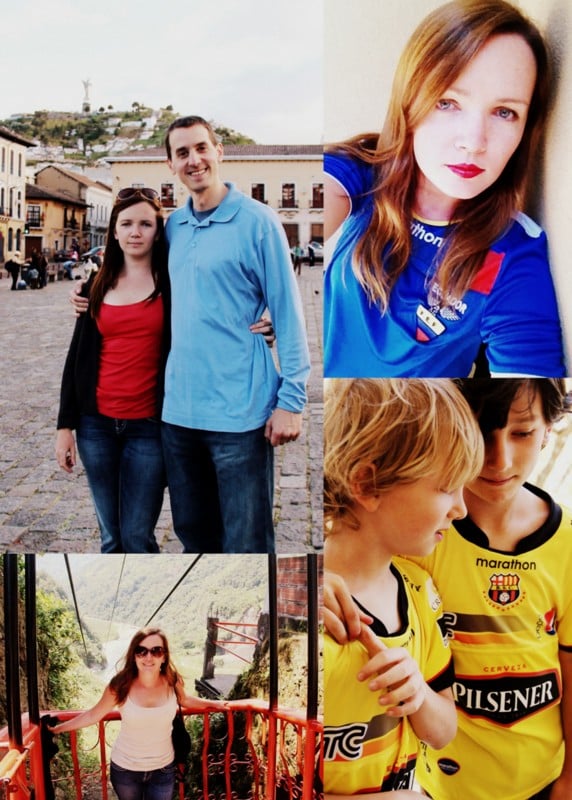
I grew up on a farm in a small town called Vilcabamba, near the city of Loja in Ecuador. I moved to the US after high school and want to school in Austin, Texas. I currently live in the Seattle area. My husband, Nicolas, who will occasionally contribute to the blog, is from France, he also ended up in Austin for school, which is where we met. We have two boys, Alex & Marc, who love to eat and “rate” everything we eat. During the day, I am very lucky that I get to work at an exciting company with a great team in a role that combines online marketing + Latam + travel (there’s only one major online travel company in the Seattle area so it’s obvious which one it is).

You could say that my family is an example of modern day nomads; my parents started it when they moved from the US to South America in the 70’s, they were originally in Colombia and then decided to move permanently to Ecuador. For both my husband and myself, there are many times when we wish we could live closer to our families and to the places that we grew up – you always miss your roots. However, we are fortunate enough to have established strong friendships with so many amazing people in the US, including other modern day nomads. We have met great people from Ecuador & France here, and many others who come from Mexico, Italy, Russia, Egypt, Estonia, China, India, Iran, Argentina, Brazil, among other places. I love being exposed to so many different cultures and of course, such a great variety of international foods.

In Texas I lived with my grandmother for a while, she is from Louisiana and is also an amazing cook. I have fond memories of all the holidays celebrated at her place, some great food memories include my grandfather’s BBQ ribs and brisket, my grandmother’s gumbo & jambalaya, her chicken spaghetti, among any others. While my grandmother’s food was delicious, I always found myself missing the Ecuadorian food that I grew up with, so I had to learn how to cook these dishes myself and adapt them based on the ingredients I found in the US. I could always ask my mom or friends for recipes, but I never got exact quantities or precise instructions: it was “add a little bit of this, some of that and cook it for a while”. That’s the way you cook in Ecuador, you learn to get the flavor right based on your “sazon” or seasoning skills. I started documenting quantities and cooking times when friends asked me to share recipes, then my husband suggested that I start a blog to post the recipes to make it easier to share. Even though my blog is mainly focused on Ecuadorian and Latin food, I will also post recipes for dishes that I have learned from friends or family, and/or that are simply influenced by the ingredients and places around me.

While I started this site to share recipes with friends, it’s become more than that and my dream is to use it to introduce more people to Ecuadorian food. This site is also for all my fellow Ecuadorians or those who have lived there previously, but are now living outside of Ecuador and miss the food. I try to keep my recipes as close to the traditional versions, but with adjustments for ingredients that are hard to find outside of Ecuador. Ecuadorian food has so much diversity, which is in line with geographical diversity of this small country; there is a wonderful variety of fruits and vegetables that grow in Ecuador. Combine this with the people, who use these ingredients in such a loving and respectful way: I think that using every part of an ingredient when you cook shows respect to it – this is shown in a simply pineapple drink called chicha de pina which uses parts of the pineapple that most would throw in the trash or dishes like caldo de pata or cow feet soup, which is made with a part of the cow that in other places would be discarded. If you’ve ever visited Ecuador, you have likely met local people who even though they barely know you will welcome you into their home and are more than willing to share their meal with you.

I’ve always loved food, though I will admit that I was a little picky as a child. One the first things I learned to cook all by myself were plantains. My food is influenced by my mom’s cooking; she grew up in New Mexico, and brought her love of spicy food to Ecuador. I remember she made everything from scratch: tortillas, sauces, bread, etc. Our house was always filled the smell of something baking or cooking. My mom’s cooking could be described as combination of New Mexican influence (think spice), Ecuadorian recipes and ingredients, but always with a healthy twist (olive oil instead of lard, homemade yogurt instead of sour cream, whole wheat flour, brown rice). We grew many of the vegetables and fruits we ate on our small farm. My mom had a small business that made several food products (herb salts, banana vinegar, cakes, whole wheat bread, cookies, etc) and would hire the local ladies to help produce these. These ladies were the ones who would tell us stories and folk tales (many scary ones about the devil), but they would also cook very traditional Ecuadorian dishes (empanadas de viento, emborrajados, locros, fritada, quimbolitos, and more) which I loved. My food is also inspired by my friends and their mothers who cooked amazing dishes, both when I was in elementary school in Vilcabamba as well as when I was in high school in Loja. In Ecuador, you cannot help but be exposed to great street food or snack food, from salchipapas to chifles to carne en palito to green mangos with salt to espumillas.

Some other random information: I love all types of kitchen gadgets and anything kitchen related (except for doing dishes), though I am currently banned from adding anything new to my kitchen gadget collection due to lack of space. I can’t cook without cumin, cilantro, garlic, limes, avocados and cheese – if I’m out of these ingredients it means I need to go grocery shopping. I love grocery shopping (especially at Farmer’s markets, Pike Place Market, Metropolitan Market, Trader Joe’s, Whole Foods, and Costco). I prefer salty and spicy foods to sweets. I was deathly afraid of bulls as a kid, so I always avoided wearing anything red when going on hikes where we might run into any bulls. I suck at sports, but I used to be really good at climbing trees – especially if they have fruit to pick.

Instructions for using this site

I realize that there many similarities, and differences, between dishes in the different regions of Ecuador and other Latin American countries; I love to hear about these differences, but please do so in a respectful way – I won’t publish comments that insult the way my dish is prepared just because in a different region or different country it is done differently. There are many ways to prepare ceviche, there are many types of locros, cheese bread and patacones/tostones are known by different names in different countries – these are all things that I love about Latin American food. Even for very traditional dishes, there is always more than one way to prepare it. Food shouldn’t be boxed into only one right way of making a dish, it’s experimenting and trying new things, adapting to the ingredients we have available that allows food to evolve and become better. The influence of Inca, Maya and Aztec empires extended over many Latin American countries. Spain, Portugal and African countries influences can still be seen today in many Latin dishes. Chinese, Japanese, Lebanese, Iranian, Italian and other more recent (last hundred years) immigrants have also influenced Latin American food. This diversity is what makes our food great and it should unite us.

I grew up writing mainly in Spanish so you will likely find some grammar mistakes in the recipes and stories. I have also been told that I write the way I talk, so please excuse the long never-ending sentences, just visualize me talking really fast and using my hands. I’m always open to improvements, so I don’t mind if any mistakes are pointed out. I learned to cook in the typical South American way of “add a little of this and a little of that” so basically without precise measurements just instinct, I do my best to document the measurements and amounts for each recipe, but feel free to adjust for your tastes. If a recipe uses an ingredient that you dislike, then either try substituting it for another that you like, but please (if you don’t like onions) don’t leave a comment that you didn’t like the dish because it included that ingredient (onions).

I assume that all vegetables, fruits, meat, seafood, etc has been cleaned properly before using so I don’t specifically say “wash the tomatoes” because I think that is quite obvious. I also assume that you know that raw fish/seafood can be dangerous and that you should avoid it if your doctor has told you so – same goes for any other medical/dietary restrictions. I also recommend that you try to use fresh, local, organic products are much as possible, I try to do this with as many products as I can, however there are certain ingredients needed to make South American dishes that are not grown or made locally (or anywhere close) so it’s isn’t always possible. I really wish someone would try growing tree tomatoes or yuca or naranjillas in Washington (or even California) because the food would taste even better. Most of the recipes are for about 4-6 people, when I cook for just the four of us, we usually have some leftovers, unless everyone is starving. I’ll try to specify in the recipes if the proportions I’m using are for a large party (10 plus people), but don’t always include this, so just ask if I omitted it.

If you have any questions or comments my email is layla at laylita dot com.

Content & photography policy

All content and photographs are owned exclusively by Laylita.com and are subject to copyright. Please ask for permission before using any of the content on this site. In general, I will allow a photo to be republished, online only – no print, as long as there is a link back to the original recipe from which the recipe was taken. The entire recipe + photos cannot be republished. Also, this doesn’t mean that all the photos can be republished on one site, it’s fine to use a few photos here and there, but don’t cross the line. I also maintain the right to withdraw the permission at any time and ask for the removal of my photos/recipes for any reason.

I don’t want to come across as unreasonable, but I’ve seen so many of my photos and recipes published on different sites, without any attribution to the original source, and it is very frustrating. Especially as in some cases, it is done by large recipe aggregator sites or even well-known news sites in Ecuador. Recently I was watching a cooking show on an Ecuadorian channel and noticed that they are using my photos without permission in their intro. I’ve even had the experience of going to restaurants in Ecuador and finding menus with my photos of them. On the one hand it’s flattering to see that something you’ve done is so popular, but it’s also unfair to not get proper credit for the work you do.